2013-06-20

Making, or Fixing

Admittedly, when I read a story that starts with this statement, my first response is to cringe.
 [She] cracks open a toaster oven, jams her hand inside, then turns on the power. It looks like she’s about to electrocute herself, but she seems unfazed. “Thermostat or heating element?” [She] mutters, yanking on wires and poking around with a multimeter.
It's an article about fixing things, rather than replacing them.


My first thoughts about fixing toaster ovens involve not putting my hand inside it while plugging things in and turning them on. But the person was probably careful not to place her hand onto a live heating element, or uninsulated wire.

The skills necessary to diagnose a toaster are useful skills. And they are skills that I have always thought were just part of life. Sometimes, the cost of repair exceeds the cost of replacement. Other times--many other times, in my experience--the cost of repair is much less than the cost of replacement.

However, I realize that many people don't have those skills. They will throw away vacuum cleaners, toaster, and microwave ovens that can be repaired easily.

It's a good idea, and a return to something that has long been part of the American tradition, to attempt to repair an item rather than purchase a replacement.

2013-06-08

Motorcycle Safety

I ride a motorcycle (when the weather is good). Among other things, this means that motorcycle riding is seasonal for me. It also means that I have to make decisions about safety equipment I wear when traveling.*

About a year ago, the government of my home State changed the requirements for wearing helmets on motorcycles. Some details are available here. I notice that most news stories on the subject seem to think that helmet laws are, in general, a good idea. They generally carry along the implication that relaxing laws about helmet use is a bad idea.

As I scanned that local news source, I found a few stories of motorcycle accidents. On a whim, I decided to search for as many as I could find, and see if there was any correlation between helmet use and fatalities. While the stories were common, they weren't common enough to generate more than 40 stories over a period of 4 years. Only half of the news stories in that time period mention whether the riders and/or passengers wore helmets.

At least once, a pair of riders on the same motorcycle suffered an accident. The helmet-wearing rider survived her session of highway-speed slip-and-slide on the pavement; her non-helmeted companion did not. Another time, the passenger who was wearing a helmet died when thrown off the cycle; the rider not wearing a helmet was also thrown off, and survived.  This second instance was in a round-about, and likely at surface-street speeds.

Was the deciding factor the helmet, the speed, or the kind of accident? Were any of these riders wearing leather jackets along with their helmets?

I couldn't find enough data to decide that, but I did arrive at these conclusions while trawling the news archive.
  • Late-night and early-morning riding is dangerous
  • Running red lights or stop signs is also dangerous
  • Weaving through heavy traffic at high speeds is dangerous
  • Cars that left-turn across the motorcycle's path are dangerous.
  • Riding across the center line into oncoming traffic usually produces at least one fatality
  • High-speed runs away from Police are dangerous, and often fatal
  • Combining more than one "dangerous" category above is often fatal
In the realm of safety, I arrived at these conclusions:
  • Helmets may help when something goes wrong. 
  • However, helmets do not guarantee safety for the rider. 
  • Many of the accidents appeared to be the fault of the rider.
  • Some accidents were the fault of other drivers.
All told, I'm not sure that these statistics contain enough data to produce a usable conclusion. One news story linked above says that the State's base rate of fatalities in motorcycle accidents is barely over 100 per year.

How hard is it to distinguish meaningful changes in that rate from statistical noise? None of the studies seem to answer that question.

That leads me to disbelieve that any of the studies has arrived at a usable conclusion. But I'll still wear a helmet when I ride. And a jacket designed to aid survival while sliding along the road surface.

2013-05-29

Bridge safety

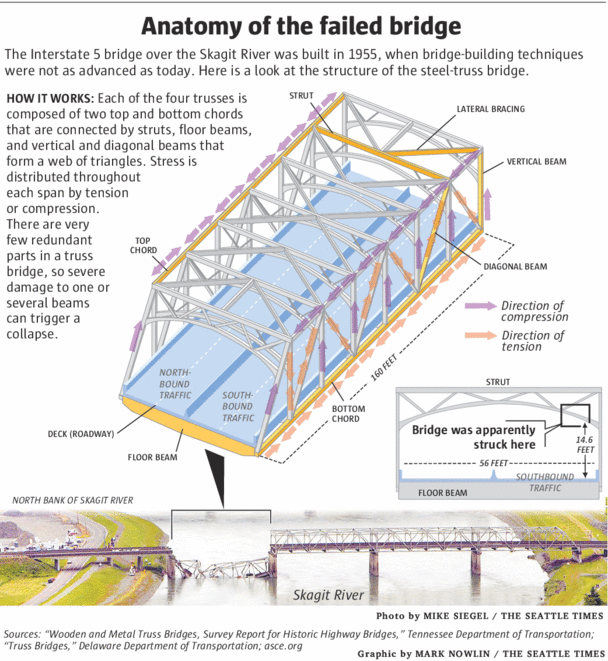
What happens when a component fails on a bridge? What if the design of the bridge makes a single failure more likely to bring the entire structure down?

These questions could be asked after the collapse of a bridge on the Interstate-5 freeway in the State of Washington.

Jim Miller (who writes extensively about National politics, and somewhat about local politics) notes that regional authorities had a process for testing and licensing for carrying oversized loads across bridges.

He also links to an article which has a very useful diagram about the bridge failure.

I've copied the image below.


Interestingly, it also appears that the inside lanes had more clearance than the outside lanes. That may have contributed to the loss, also...

2013-05-27

In Memoriam

The history of the United States has many wars, and the wars have produced many tales of honor, courage, and bravery.

And many men were buried when the action of the day was done.

This day is set aside as a day of memorial.

2013-05-23

Unexpected article

Not unexpected information, but at an unexpected place.

Instapundit references Mother Jones, which published an article about building an AK-style rifle.

The author gives a short description of a build-party he attended, and mentions some details of the process. But he doesn't mention enough to allow many readers to reproduce the process themselves. However, it's not as if such info is hard to find.

It's a process I've heard about, and may do myself one of these years. The weird part is that the market for AK parts-kits (plus barrels) clears at roughly the same price as professionally-manufactured AK rifles. Thus, I pay the same cost either way.

However, if I were to build my own rifle, it would be mine in a way that a purchased rifle would not be.

There was a lot of attention given, recently, to the concept of building a home-made firearm from a 3D-printer. While such things may be of interest, it is worth remembering that expensive, computer-controlled tools are not necessary to build an AK-47 rifle from a parts-kit.

I strongly doubt that either process is likely to see much use by criminals in America. There is apparently a large number of firearms already in the black and gray markets. From data gathered by the Dept. of Justice, most of those firearms are pistols. Many were stolen, or purchased through intermediaries who don't mind re-selling to prohibited persons.

The article at Mother Jones was informative, though I doubt the wisdom of the man destroying his firearms so soon after building it. He should spend time learning the strengths and limitations of the tool.

2013-05-12

Urban farming, blood and guts

I've got a relative who is engaged in urban farming. It feels odd, but a combination of factors make it easy for him to engage in small-scale farming.

Part of the venture involves chickens. This is something new, and he is still learning about the chickens and their handling.

Last time I visited, I walked into the chicken area to view a site of frightening carnage. A varmint (likely a raccoon) had discovered the chickens, and harmed many of them while reaching through the chicken wire.

A disturbingly high number were dead from blood loss, and a few more were wounded yet still breathing. Some chickens had been gutted, a trail of intestines and blood was on the floor of the chicken-pen.

The sight was shocking, but not gut-wrenching. (At least, not to me...) I cared enough about the farming project to pitch in with cleanup. I also helped acquire better wire-mesh for the chicken area.

Much later in the day, after acquiring and deploying a live-trap, we found the masked bandit. It was a raccoon, as expected.

We tried dispatching it with a pellet-gun, but the projectiles didn't carry enough momentum to harm the animal.  It was still in the cage of the live-trap, and we wished to dispatch him before nightfall. For several unrelated reasons, I was left with the task.

I decided to carry the cage down to the nearby river. Some cable was used to make lowering the cage into the water easier. A brick, tied to the apparatus, enabled me to be sure the cage would stay under the water. After enough time had passed, I lifted the cage back out. The carcass of the mischievous rodent was dumped back into the river.

I've done a little hunting in my time. This was a little different, but not overly so. That creature had done damage; there was no easy way to send it away and keep it from returning. The kill itself was easy, after a little preparation.


So far, the better wire-mesh has kept the remaining chickens from harm. This little episode reminded me that every form of farming deals with varmints who enjoy some free food. Even varmints that can't eat what they kill, but will keep attacking in an effort to find something it can eat.

Though I think I'm happy that I'm not depending directly on a single urban farm...

2013-05-03

The sound of spring

I've heard spring sounds in the air on and off. Seen robins, blue jays, and red-winged blackbirds.

In my area, April often brings a collection of heavy rainshowers, sometimes with thunder. Those sounds have not been missing.

And last weekend, I heard what I think is the definitive sound of spring. The sound of a motorcycle engine* running. In this case, the first time it ran since last October.

Almost 100 miles of riding later, I was convinced that the cycle was running fine.

The shakedown cruise was a pleasant 20 miles or so on Hines Drive. Thanks to Ed Hines and Henry Ford for setting up that park, and its pleasant path through central-and-Western-Wayne county suburbia...

The rest of the days travel were to visit a friend, and later attend a small party hosted by a different friend.


*the engine in question is a 30-year-old Honda inline-4, 750cc displacement. It has a pleasant rumble at idle, and a medium-high roar at high RPM values. Maybe next year I'll get a machine that is less than 20 years old...this one has some signs of age, but the engine, controls, and frame are in good shape.